Overview
Service Request microservice is an order management system that can capture different service requests that are raised by the customer in the Digital Retail Banking channels. Service Request microservice maintains the life cycle of all the service requests.
The service requests involve services such as New Cheque Book, Stop Payment Request, Dispute transactions, and Block Debit Card.
Banks may require different systems to process different types of service requests. The Service Request microservice integrates with multiple systems for processing.
Banks may request different styles of order processing for different types of service requests. The Service Request microservice supports the following types of Order Styles:
- Real-Time: When the user submits a service request from Online Banking, the order is captured in Service Request microservice and is instantly processed by the core system. The acknowledgment that is shown to the user is based on the response from the core system and the Service Request microservice.
- Near-Time: When the user submits a service request from Online Banking, the order is captured in the Service Request microservice. The acknowledgment that is shown to the user is based on the response from the Service Request microservice. Subsequently, the request is passed to the core system for processing. The upcoming request status is updated to the user based on the response from the core system.
The key features of Service Request microservice are as follows:
- It captures the service request raised by the customer.
- It supports Real-Time and Near-Time processing styles.
- It integrates with multiple systems for processing.
- It tracks the service request status.
- Service Request status mapping allows to send meaningful status to customer-facing application.
- Currently, Service Request MS sends requests to many different back-end systems for request processing and which in turn each request many have different responses.
- For example, to indicate success for any request processing, one system might return OK, while another returns Complete, which would not be able to parse all the individual statuses to customers returned by the back-end systems.
- Request status mapping in Service Request MS allows the bank users to send meaningful status values to a customer-facing application.
- To manage the request status mapping, Service Request MS provides the following:
- The bank users can add a set of possible source status for each request sub-type which is received from the back-end system for the entire life cycle of all service requests
- The bank users can add a set of target statuses that have specific requirements for each request sub-type.
- The bank users can map the source status to the desired target status for each request sub-type.
- The users can view the current status as per request mapping status (Target Status) for any request sub-type.
The advantages of Service Request microservice are as follows.
- To serve different types of service requests such as New Cheque Book, Change of Address or Contact Number, Bank Statement, and Interest Certificate, the Service Request microservice provides an abstraction from the core in Infinity.
- It maintains the service request configuration that is supported by the system.
- It persists the service requests placed by the customer.
- It keeps the status of the service request updated.
- It supports real-time and near-time requests.
- It performs generic validation on the incoming request before the request is submitted to the core.
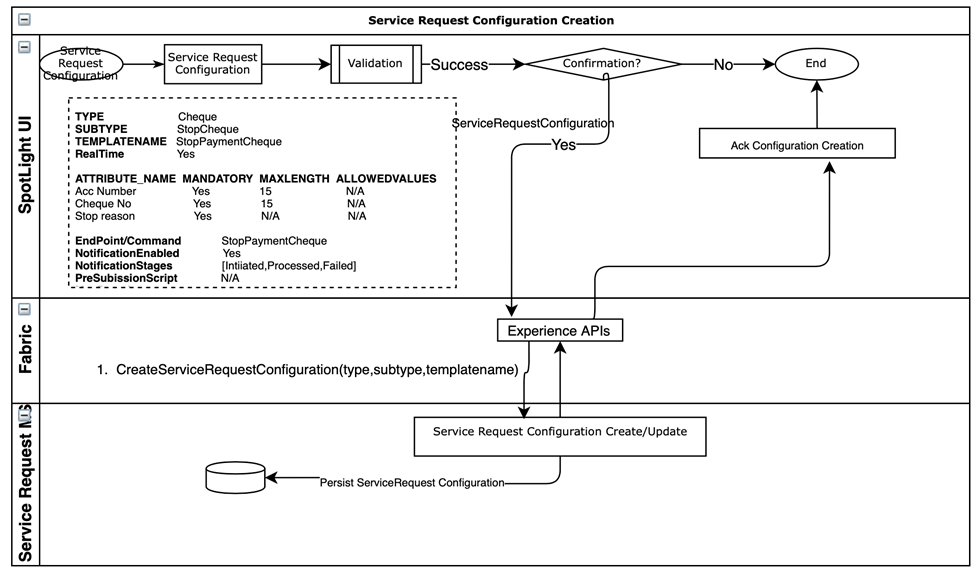
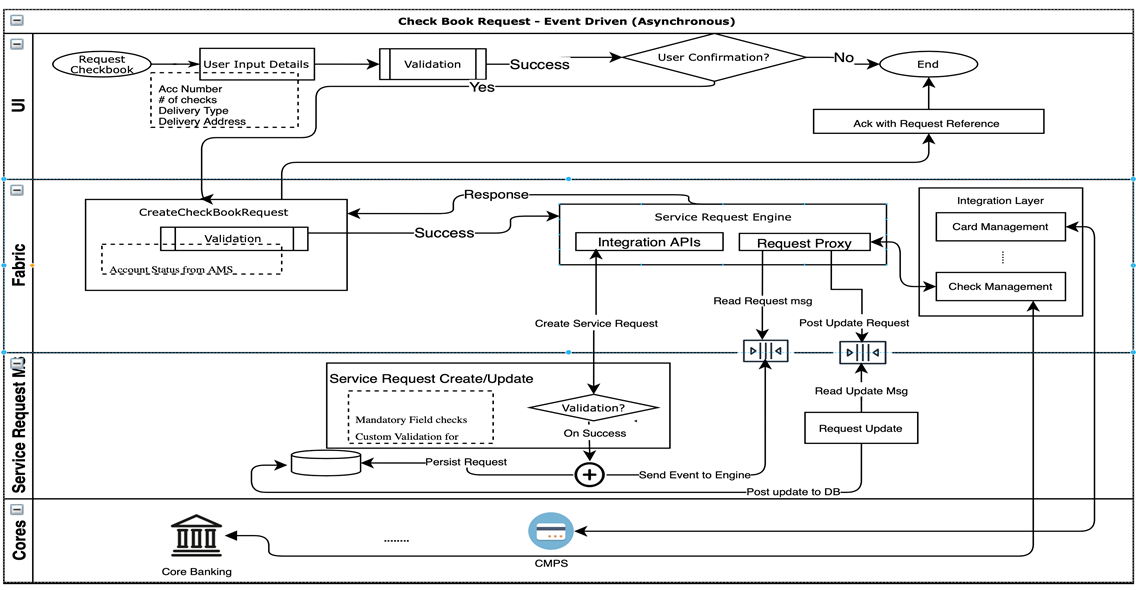
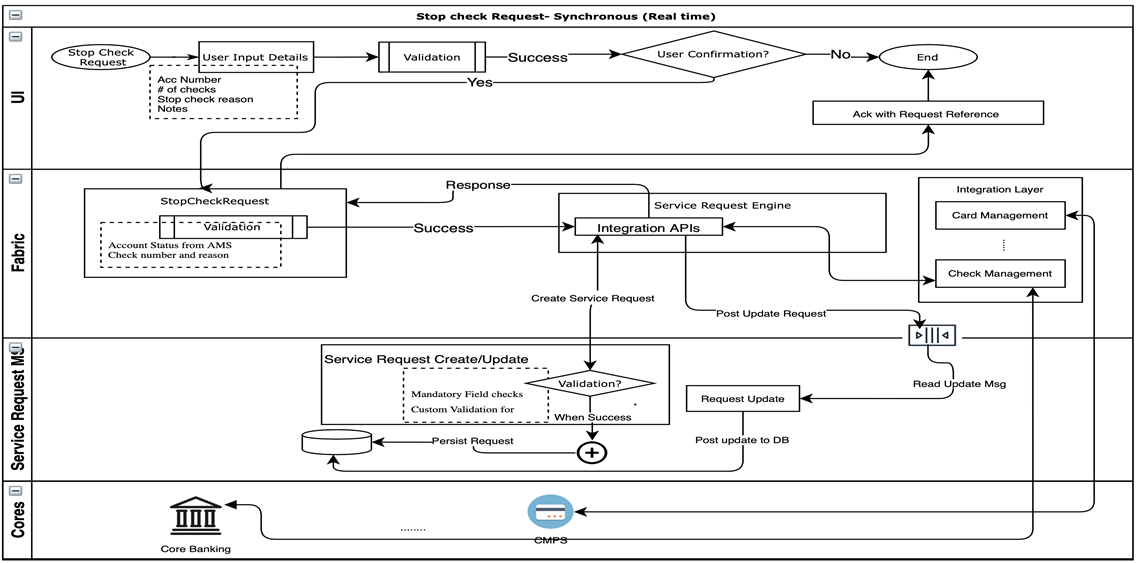
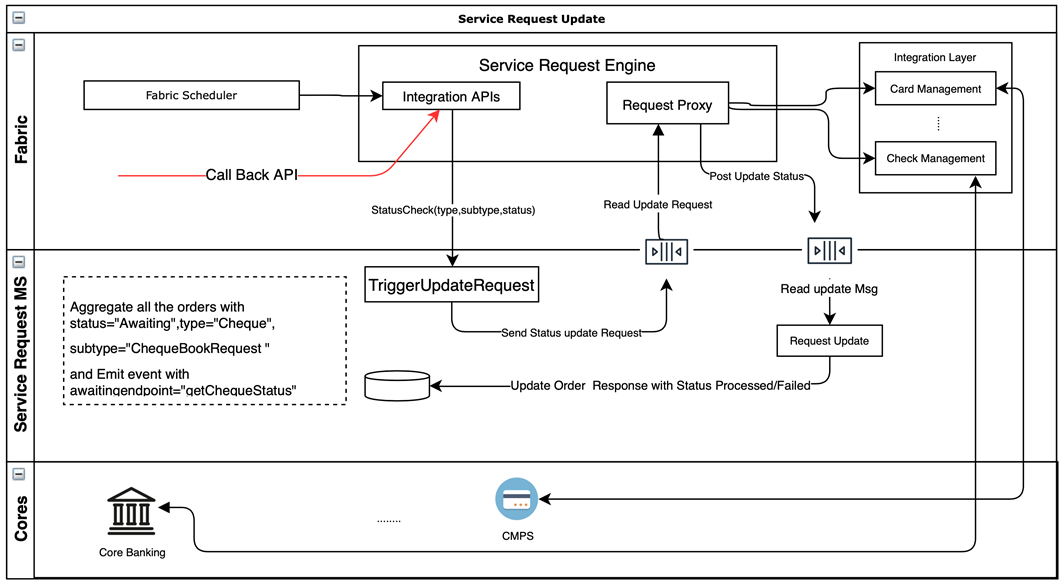
 Technical Overview
- Service Request Engine:
- It is a Fabric application.
- Act as a proxy to route request to correct endpoint.
- provides integration APIs to connect with MS for other application.
- Exposes call backs for core to get real-time updates.
- Schedule various job to get the periodic update on requests.
In this topic
